


Failed to render LaTeX expression — no expression found
n I was about 10 my mom read “Alice’s Adventures in Wonderland” to me for the first time. She would read pages from the book to me as I was falling asleep in my bedroom near the wilderness of Eaton Canyon National Park, where I grew up at the foot of pine-dusted mountains in a house on the corner of a street named Old House Road and a street called Sierra Madre1 (‘mother mountain range’ in Spanish).
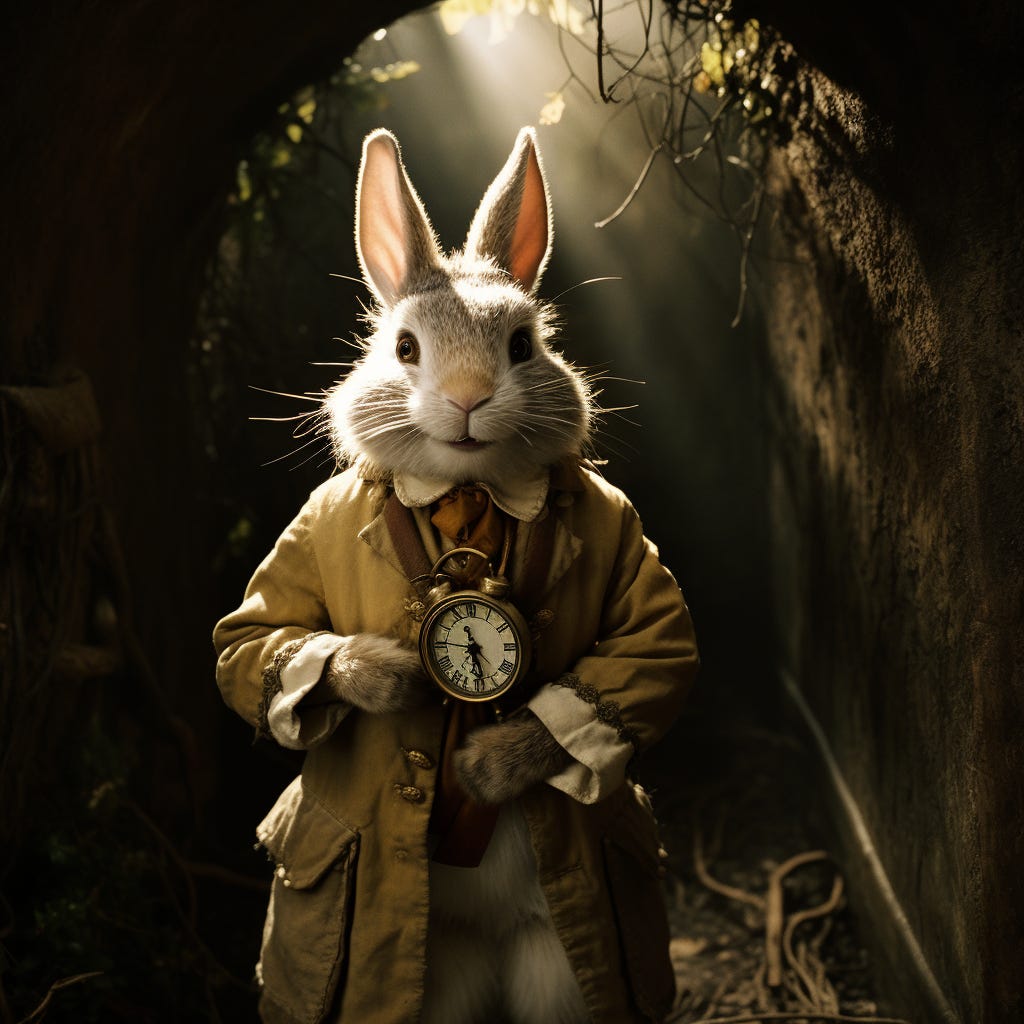
I fell in love with the story immediately—it starts with a girl who’s lazy with boredom and follows a rabbit with a pocket-watch down a rabbit hole—falling, and falling, and falling. As she falls she thinks of her cat Dinah, and despite her own grim situation of falling into an endless abyss she is mostly concerned with whether anyone will remember to give her cat a saucer of milk at tea-time.
I knew I’d eventually have a cat named Dinah, because following an impossible creature into a nonsensical underworld and worrying about my cat seemed like exactly the type of thing that I would grow up to do. And I was right—about the cat, and about the rest of it. I even woke up in jail once with a hangover and fretted obsessively about whether any of my roommates would notice my absence and feed Dinah (and Prince Charming). They didn’t, but that’s not the point of all this.
Back to 10 year old me reading about this Wonderland place—I was transfixed by the book’s promise that somewhere under the surface of the mundane world there was a world full of magic and nonsense that I could travel to and be a part of.
I had started out in life feeling very magical and in touch with different versions of life. I had memories of being a dolphin in another lifetime and vivid dreaming, an alien encounter at the age of 5 with an entity named Jack, and a roving and tireless imagination that constantly propelling me through various states of awareness.
By 10 years old, though, I had already been thoroughly debriefed on the rules of this reality—there is no such thing as magic, dreams are just bits of pointless fluff between your ears, and imagination is a pointless enterprise that won’t spare you any pain in life.
Despite this, I felt so sure that there was a magical world somewhere, if I could only find a rabbit hole. And so I prayed (even then, my journals were prayer-books addressed to an unnamed power) and promised that if a rabbit hole revealing a passage to a magical world were to appear in my closet the next day I swear I would keep it to myself and not tell anybody and also that it would renew my will to live and my faith in magic, which at the time was synonymous with God.
When I opened my closet the next day and searched the entire back wall for a hidden door only to find smooth drywall, it was my first crisis of faith. I stopped believing, and I turned my attention to science.
I’m sure I don’t have to explain (please don’t make me explain) that science and spirituality are no longer considered mutually exclusive, but at the time (and still, in machinistic antiquated scientific systems) science was promoted as an antidote to religious thinking. If I couldn’t find Wonderland, I could try to discover what was wonderful about this world.
Anyway, fast forward like 26 years.
I’ve found Wonderland many times over by now, though I’ve learned that it can’t be accessed by petulant demands nor can I expect it to look or feel as concrete as this reality does. This reality is a wildly convincing illusion, and wonderlands are only so vivid in sleep or while on some really powerful drugs. Some people can get there with meditation, and—as I’m getting to the point—I’ve most recently figured out that hypnosis is an excellent secret closet door to those worlds.
It’s a shame that most peoples’ perception of hypnosis is based on stage acts and cult leaders, and even a simple google search produces a definition that claims a loss of voluntary action.
In reality, we are always weaving out of hypnotic states and you’re no less incapable of voluntary action when working with a hypnotherapist than you are when you get into a trance state driving a car on a familiar route or watching television.
The difference between hypnosis and hypnotherapy is that hypnosis is the altered state of consciousness notable for its heightened relaxation, sensory awareness, and suggestibility. Hypnotherapy is just the practice of using this altered state to access subconscious material and programming so that negative programming can be transformed and preferred programming put in its place.
Imagination is a function of the subconscious mind. When we are profoundly relaxed, our nervous system is chilled out enough that we are able to sink into the subconscious mind. Imagination is where doors to wonderlands exist, and a fun part about the subconscious mind is that it is not responsible for calling out what is ‘real’ or ‘not real’ within a framework of reality that’s limited to three dimensional concrete Earth-bound awareness.
Plenty of studies have proven that if you imagine yourself to be doing something like running or practicing a skill vividly enough, your body responds as though you are actually doing it—neural pathways are built, hormones are excreted.
So anyway, that’s a quite longwinded way of saying that if you just relax really deeply (AKA enter a trance state AKA state of hypnosis) and let yourself imagine a door to a magical nonsensical world, you can actually find a door and touch it and open it and walk through it and access some nonsense.
Why would one want to do this? Well, this introduction was supposed to be just a paragraph but it’s become a whole chapter in its own right, and I haven’t even gotten to the Door of Truth—so I’ll leave the why and how for part 2. But here’s a teaser—
Wonderlands are where gods live. Our own personal Jesuses. And there’s no prescription or tithe or dogma to swallow. The hardest part of gaining access (and I won’t pretend this isn’t hard) is just the willingness to believe that the content of your imagination is the substance that connects you to the source of everything.
To be continued…
I would mistakenly believe that the mountain range I grew up near were the Sierra Madre mountains because of this, and because I think people around me called them that. I didn’t learn until way, way, way later that these are actually the San Gabriel mountains. Weirdly, I ended up moving to a region in Mexico that was right near the Sierra Madre mountains eventually, so I guess it was bound to happen at some point.